Following mine and Gary's last major travelling expedition in Vietnam, we decided to explore a different type of landscape... Costa Rica! Originally planned for last year but we chose to move in together pending our imminent uprooting.
Rather than a day-by-day, hour-by-hour narrative of what we did, we're going to let the pictures do most of the talking - and rightly so as there's lots of them! At the bottom there's a 15 minute video featuring nonsense, animal encounters including terrifying howler monkey sounds and daring adrenaline activities.
We were in Costa Rica from 17-30 April, with a short stop in Mexico on way back, 30 April-1 May 2019. A place packed with beauty, wonder and adrenaline - it's all about the conservation of wildlife and well-being of people. Here we go...
San Jose
We made it to the lush Costa Rica. 🌿🌺🐦🦎🐒🕷🐚 From the animal books I grew up with to seeing them for real. 😍 My man organises us the best travels - a perk of being with a traveller (I get the 'life admin' jobs 🤭). Hoping for serious Jurassic Park/World vibes! Adventures and activities await us...
Spending the Easter weekend in San Jose. Celebrating when Jesus emerged from an egg according to Danny! 🤪
Visited the Pre-Columbian Gold Museum and learned some history of Costa Rica and their coins. We wanted to visit this on one of the first days arriving here, but was closed due to Easter celebrations. So upon our arrival back at the start after the group expedition (to follow) we visited it.
La Fortuna
From San Jose to La Fortuna! On the way, stopped at a waterfall viewpoint. From seed to shipping at a coffee plantation. Animal spotting around hotel (animal pics to come... 😱) and colours of Costa Rica. Then dipping into Arenal volcano hot springs at night!
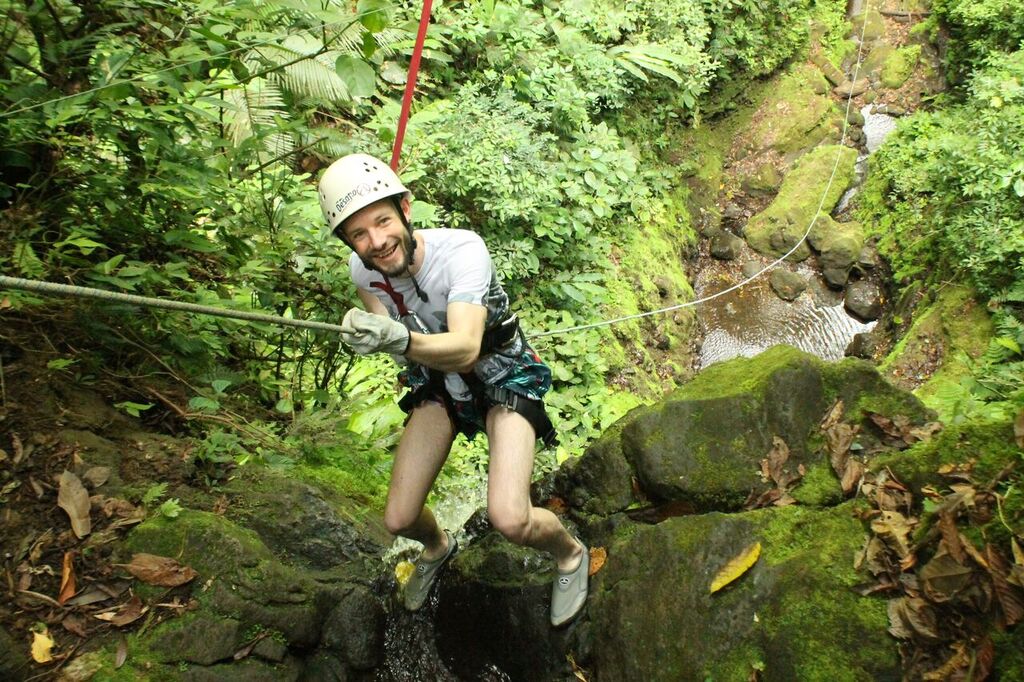
Canyoning first thing in the morning! We strapped on our harnesses for a bit of fun! It was really awesome being in the rainforest rappelling down waterfalls and getting soaked. Danny didn't bring swim shorts so he had to wear Gary's, leaving his legs looking like twigs, more than normal.
Fully immersing ourselves into the natural side of Costa Rica. A swim at the impressive La Fortuna Waterfall, the tallest in Costa Rica and then getting a closer look at the imposing Arenal Volcano.
Monteverde
Travelled onto Monterverde via boat across Lake Arenal. Walked across the hanging bridges in the cloud forest (clouds weren't there 😔) taking in the sights from great heights. Then we did a night walk in a Monterverde forest - pure blackness, saw sloths, possums, armadillos, vipers, scorpions, frogs, sleeping tucanette, fireflies... and way too many bugs, all of which were attached to me. 😱
It's all about nature and wildlife in this beautiful country so we took a tour in the cloud forest. The animals are all around you, birds, monkeys, sloths, iguanas, you see it all. The other side of the country is the adrenaline activities, we've done Canyoning and Ziplining for the rush!
Later we flew above the cloud forest! It felt like being in a dream getting those birds eye views, so cool. It was literally the definition of breathtaking. As usual, the pictures don't give it justice - so check out the companies video to give you a better idea of what we did. 😱
Fauna of Costa Rica - all seen in their natural habitats! You don't even have to try to see wildlife, it's just in front of you all the time. Danny couldn't get enough of them constantly walking, climbing, flying and swimming around him. Danny didn't get pics of everything he saw, as some were too quick or missed opportunities because I was in such awe watching them. Like spider monkeys, howler monkeys (see video at bottom of Danny listening to their howl at 5am), possum, agouti, snakes, dragonflies, ferral San Jose parakeets, scarlet macaws, plus many more birds! The iconic keel-billed toucan was Danny's animal of the adventure. He was lucky enough to have seen it twice, once when I loudly interrupted our ziplining induction. 🤭
Quepos
Bonding with our travelling family on a huge catamaran. Plenty of fun jumping off the boat and on the slides. Even dolphins joined in! Ended the day watching the sunset followed by impromptu drinks on the rooftop pool at the hotel, ending/beginning with a slight hangover.
It's not a holiday if you don't go to the beach! Manuel Antonio beach ranks up there for the best one Gary's been to. A stunning bay with pure sands and turquoise waters surrounded by lush vegetation and families of thieving animals (ok that last parts not so nice 😂). Sorry Railay beach in Thailand you might be knocked off the top spot!
Mexico City
Landed in the early evening, ventured out to explore the City and search for our grub. Found a unique restaurant with a huge tree in the centre.
In the morning we visited the temple ruins and museum, literally just around the corner from where we were stopping. Saw more of the city, then later that evening we went to the local cinema to watch Avengers: Endgame as we couldn't wait. Hilarious experience of Spanish adverts and subtitles.
So, here's our own piecemeal video bringing together some recordings we got, in a variety of angles and qualities. It's 15 minute long and is in chronological order that gives us a great memory to look back on.
Travelling is not right without a bit of reflection, so here is ours:
Incredible how we all gelled together as a group. As it's 'forced' at beginning it can go either way, but we all became great friends during it. Getting to know each other and helping one and another through activities. Memories and friendships that will last a lifetime.
Our hearts have been imprinted with the Pura Vida (pure life) lifestyle of Costa Rica - focused on happiness and well-being not power. Why can't all countries be like this?!
Flor, our group lead guide did an impeccable job at organising us everyday and keeping us safe. So knowledgeable and helpful. Thank you. 👏 We were pretty lost afterwards - please carry on organising our lives!
Danny was inspired to get more involved with wildlife locally. Plus thinking of ways of how he can get involved with Costa Rica from a distance. He might contact Berny (wildlife guide) about some ideas.
So, I have decided to present at the ALT Conference 2019! This would have been my second time, but I withdrew my submission from 2017 'Progressing effective ILT through organisational research' due to impending job change. It’s my first time actually attending the day event and I am really excited to be there and experience it in its fullest.
From a conversation I had with Marcus Elliott back in February 2019 on what I could present.
Me - "And thanks for leaving me with thinking about "it's not about what I have done, but how I approach and challenge things". I hope that is transparent with me, but yes there is some focus on the 'I' as that bit needs to be somewhat visible."
This blog demonstrates my thinking and approaches to my work (and life). I could do with articulating this and expressing it more easily in face-to-face conversations.
Marcus Elliott - "I was just thinking about from the perspective of an audience at a conference: I'd want to know how and what you did might be applied to my practice..."
I obviously collaborated with others on their knowledge and skills, but I now really see the value of positively questioning and challenging others thinking and approaches as that will help me to understand more about the bigger picture. As I once said, it's all about asking the right questions that prompts us for meaningful answers.
He was asking me what I would like to present etc. I went on to say “well I can show and talk about this” etc. He suggested that instead of presenting an output of something I have done, how about I change tack and talk about my thinking and approaches to my work and projects that I am presenting. Whilst in previous presentations this has been visible and strongly on my blog, it’s not been a focus. So I really welcomed his suggestion on that and it’s gave me a sense of buzz to talk and present more about my thinking, research, evaluation, reflections on wider topics. While it may appear an obvious suggestion, it’s given me a fresh perspective and doing presentations at conferences and events. To me I feel like I had it ingrained in me that I had to present something that I have accomplished or created, which is always welcomed. But many may not find that as appealing. Especially if the presenter egoistically boasts about themselves. 🙄 It may not just be my thinking and approaches, it could just be something that I am passionate about – that’s just as powerful and inspirational. Which I do love to talk about the things I enjoy doing.
So, this is my session for ALT's Annual Conference 2019, scheduled for 3rd September. This blog post contains my session proposal and my messy incoherent mind dump of notes of how I arrived at this topic. As I seem to have took a huge topic, I've had to downsize severely for the 30 mins I have. So the pre-thinking and notes act as preceding material for the session. It’s not essential reading for anyone coming to my session but provides you with some background information and thoughts that can help you reflect in the session. Might be worth a read - who knows.
For my main ALTC experience, I'll do a separate blog post 'ALT Annual Conference 2019'.
During an internal strategy development programme, to develop a bold and ambitious digital strategy for the future of the university and how we can better ‘harness’ digital. Divided into workstreams to look at closer issues, I was inspired by our small group’s discussions on the theme of ‘purposeful technology’ for context/role, audience, tasks and location. I echo and was instantly drawn to what a colleague said "my overarching feeling is that this is primarily about an approach to using technology rather than necessarily being a specific set of actions." I am keen to explore a 'philosophy' of what this is and can look like for Technology Enhanced Learning (TEL). It has led me to explore this separately in my role, broadly as a learning technologist.
In my many years of learning technology experience, you can't just use digital technology just because you can and it's different to what you have used before. What is the rationale underpinning it? It's also about the attitudes or improved behaviours with the digital technologies we have. For example, Virtual learning Environment (VLE) minimum requirements can encourage inappropriate digital practices into making it a repository. Digital technology is not always the problem as many suggest, it's how we use it, the behaviours involved – the challenge. When you keep adding stuff onto something over a long period of time, it gets bigger and somewhat a mess. It may be that purposeful technology needs to be a redesign to make a 'step change' – deconstruct it all and rebuild without the extra unnecessary slack. Perhaps educators need to approach this as a philosophy to guide positive thinking and practices around digital technologies.
In this reflective session, guided by Brookfield’s (2017) Four Lenses of Critical Reflection I will explore my thoughts and perspectives on this topic, present an outline for discussion and evaluation with participants of what this means to educators and to consider its wider value and to help strengthen a commitment to a core philosophy. The session is suitable for anyone in higher or further education that support and develop digital learning. From attending this session you will gain:
Insights into what is meant by purposeful technology
Opportunities to contribute to the development of this thought piece
Ideas on how this can be applied in your own work/organisation
This evaluation supports the ‘Critical frames of reference’ theme by analysing, grounding and encouraging positive digital practices. I feel that purposefulness as a theme is a common issue for TEL, one that many educators think about but not sure how to visualise, represent and implement.
Questions/areas to be explored:
What are the underpinning principles of a purposeful technology philosophy?
How do we reduce inconsistency of application and implementation of TEL?
How do we provide staff time to try low stakes experimentation and evaluation with digital technologies?
How can we improve TEL communications to academics to help them easily access and evaluate digital technology for what they want to do/achieve?
How can we improve the visibility, access and promotion of sharing good practice?
Further supporting information:
This will become a blog post that will be shared internally with the university and externally to the wider #altc community.
References:
Brookfield, S. 2017 2nd edition. Becoming a Critically Reflective Teacher. San Francisco: Jossey-Bass.
Pre-session thoughts - a messy incoherent mind dump
The following sketchy thoughts, in no particular order, were curated throughout the 'Harnessing Digital' programme lens at Nottingham Trent University (NTU), a focus theme of NTU's 2025 strategy. I hope this goes some way to forming a picture of the topic's origin.
Born out of the ‘Harnessing Digital lens’ of NTU’s 2025 strategy, as a side project I am leading and exploring 'purposeful technology' as a philosophical approach to the adoption of digital technology.Sometimes you have to go through all the complex stuff, making sense of it before getting to the simplistic stuff.
'Purposeful Technology' was a workstream of the lens, in which we discussed a whole spectrum of experiences and issues. I contributed well given it’s a big interest to me. Whilst small but visible, I am proud to see that I have made an impact on these discussions. I put some thoughtful ideas for consideration on the table, which are present and weaved into the following comments. I also heard my voice through others’ conversations and papers. I'm tabling this motion (how very political of me) of 'purposeful technology' as an approach/philosophy and what it would look like.
Culture and informing decisions A lot of time needs to be focused on building the culture of appropriate and successful use of TEL – the vehicle, not always about the solution. A bit like recycling – we know solutions but the issue is getting people on-board and to do it. I have always thought it's not just about selling benefits, but knowing the consequences of your choices, decisions and actions. Also, there needs to be more time to understand the decisions people take of not only using a tool, but why not. What informs their decision making?
Purposeful technology was a key topic throughout other workstreams and strongly linked to organisational culture. It may not be about the technology, but the purposes. What do we want to achieve? This guides our options, choices and the subsequent question. What technology best supports the purpose?
Purpose
Usually what happens is:
New digital technology that needs to be used, that comes with little or no support or direction
Being given/forced to use digital technology that has been bought in
Too much digital technology to choose from
Time learning the digital technology to find out it is not the right tool.
Lots of digital technology to use and inconsistency of application and implementation – make better communication and strategy around core digital technologies? In our group I suggested "how can we help academics to easily evaluate digital technology for what they want to do/achieve?" It's always a challenge and is a communication issue. Simplicity is key here and I always I hear and see it a lot from staff.
People using tech ‘just because you can doesn’t mean you should’, without underpinning purpose and rationale.
Argument of pedagogy before technology – but takes time and space to practise to make informed decisions.
TEL often confused with time and cost cutting, class contact time than any real pedagogical consideration, i.e. how best to design TEL into the learning and teaching experience?
Purposes can change and we don’t always move with it. Like when getting rid of clothes, we hang onto them because we like them. But will we use them? No. They no longer serve a purpose. That's why I usually ask myself will I wear this in next 6 months. But it all does depend on the occasion. Overall, if it doesn't excite you anymore then but something current. May be there's lessons in here for using TEL, current, relevant are variety.
Lack of or no TEL strategy – just statements, pledges, policy and guidance of how to achieve it – no clarity on specifics and digital technology we have to support it.
Do we focus behaviour change towards a philosophy to guide positive thinking and practices around digital technologies and TEL?
We often miss out context and the adding value bit. We need to drill down to the contextual use otherwise TEL is not being used effectively. Case studies and sharing good and poor practice is useful here.
Not only should we assess/audit digital skills, but examine the values and attitudes of teachers and how that informs TEL decisions and most importantly belief that it works.
When you keep adding stuff onto something over a long period of time, it gets bigger and somewhat a mess. Perhaps purposeful technology needs to be a redesign to make a 'step change'. Deconstruct it all and rebuild without the extra unnecessary slack.
Start with reflecting on own digital fluencies as that affects your perceptions and beliefs as it determines how much or little you use it in your pedagogical practices.
Is this about being purposeful to the teacher, learner, activity, programme, awarding body etc?
This should not be about legislating, but educating all staff on the purposeful use of digital technology. Both digital technology and skill should come hand in hand and that is in the form of the task, at hand.
Is purpose critical digital pedagogy, as in mission critical?
Software and tools can somewhat inhibit creativity as you have to work in their boundaries and parameters. That’s why I am a big believer in storyboarding and sketching out ideas first, then choosing the digital technology that can achieve this. Avoid shoe-horning and making something fit – square pegs in round holes.
Purpose is about clarity and why this tool/system is appropriate or is better than existing ones.
Is purpose surrounding the principles of the SAMR model, 3E framework or DEP model? A need/reason to change something and make better.
Purpose could be about what tutors’ beliefs in it fulfilling their pedagogical desires?
Purpose depends on your philosophy or how teachers perceive their role.
Setting ground rules of the intentions of use is one thing and using digital technology with purpose, i.e. the activity/function is another – the behaviours involved. There needs to be an identified purpose otherwise why are you using it, or what should you use it?
We have a huge spectrum of digital technologies at our hands, all multi-purpose that can be used for many reasons, but what are these reasons?
Purposeful technology may turn into a TEL strategy… Purposeful technology should be part of a wider TEL strategy, not a digital, ICT strategy, which should seamlessly be wrapped around the university (organisational) needs and its people. Many suggest that a TEL strategy should be part of the main university and not be understood in isolation. Whilst I agree somewhat, purposeful technology should have prominent visibility and I am not sure that it could be seen in a central university strategy? Perhaps it could, but how can this have prominence? TEL is specific, complex and strongly connected to learning. To me a good TEL strategy should focus on aspirations and a cultural movement rather than a shopping list of solutions. I think we all know that these 'solutions' won’t be resolved and will most likely keep getting rolled over to the next year and so on. Focus on the behaviours the organisation wants to have rather than creating a forced 'you must do' culture.
Broken down, do we need:
A TEL strategy – philosophy/principles
Digital Induction – starting point on introducing organisational tools and systems
A digital capabilities framework to support and progress it
A diagnostic tool to ascertain current understandings, attitudes, behaviours and skill
Time for CPD/spaces for sharing good practice.
There needs to be a clear and solid TEL strategy. This should be a common set of aims/goals along with principles on how all involved in digital (which is pretty much everyone) can work to and progress their practices. We have a digital framework (choices to rework it or start afresh), a digital audit tool and Digital Induction. All of these should marry up into some sort of pathway. Then there needs to be some sort of focus on the measurement of this, which derives from the framework. Used in conjunction with the digital framework, the outcomes of the digital audit tool can be integrated into appraisal or vice versa with the framework.
Where is the clear purposeful technology guidance? I don't mean minimum requirements. If I was a new academic member of staff, where and how would I know that I am working to the shared common TEL goals of the organisation?
Affecting factors
Choice/flexibility – what does it mean?
People need to be able to change and own things.
What are the behavioural and attitudes changes of TEL do we want our organisation to have? Then sourcing and matching the right digital technologies to these behaviours.
Don't want to stifle innovation, but how is it governed and what are the minimum standards we want?
What do we want to achieve (new and innovative pedagogies) in our curriculum, classrooms, lectures? Not just focusing on what will the digital technology allows us to do.
What kit are lecturers expected to use?
People using different digital technology and how can you easily share practices across everyone? Learning to share effectively.
We have core digital technologies like the VLE we manage but some parts like Turnitin we can't manage.
Some organisations model of resource led (self-help) is not ideal, not underpinned and embedded.
Consistency of the use of tools – staff with different and higher digital skills are giving different groups of students different experiences.
Staff need time to focus energy to make digital environments better.
In terms of resourcing, staff are in a minority with kit they have (mobile and tablets) compared to what students have access to.
Change is always in response to something – so what is the something, the organisation? What are we not doing? It should be driven by the activity of people not the technology.
A ‘step change’ is a re-engineered process, not just how you do something.
Allow students to choose when they are assessed – change the process to be more personal?
During the lens programme board talks, I noted:
I heard mentions of "building in engagement and social aspects into learning technology" Am I wrong in thinking that this should be already in place and essential within TEL?
Also "direct staff on how to change their digital practices, what to do and why" – we are doing it (for years) and so are other people in the organisation. I'm hearing the same comments – again, am I wrong in thinking that we need to focus on stuff that is currently happening and making this better, whilst examining what the organisation needs. What are we not providing?
The session
Outline of what was covered:
Not academic research, I am sharing current thinking
It’s stuff we already know, but how much do we understand, communicate and subscribe to it?
My aim is not to legislate but to educate the importance such approach
In September 2019, NTU launched it’s strategic ambitions known as NTU 2025. Contained ‘lenses’, our people, lifelong learning etc, harnessing digital is one of them. Within the lenses were a number of workstreams, I joined the purposeful technology one. General recommendations that came out were increasing personalisation and differentiation. Whilst good and relevant, I felt there was deeper topics to be addressed and discussed, so I decided to reflect on this and seek other’s thoughts on it.
NTU students asking for consistency in VLE and other digital tools
Case for setting boundaries and understanding and reinforcing consequences
Peter Bryant's quote reinforces my message, it would have been useful to have in earlier workstream conversations to steer them towards this thinking
Some headlining reflections:
People using digital technology just because they can, which doesn’t mean they should, without underpinning purpose and rationale (try and fit pedagogy in afterwards, rather than the reason)
Or sometimes we identify a purpose and it loses its meaning as we don't review it regularly or audience needs change. Like we go to our favourite tools like Padlet as we trust it, which is good, but we need to re-evaluate still before using with new audiences
Mission of pedagogy before technology – but takes time and space to practise to make informed decisions
We have 3E framework, DEBATE acronym etc for example that encourage this - do they work? Not an easy process to evaluate TEL. It shouldn't be a rushed job, but can be made an easier and clearer process
Lack of or no TEL strategy – just statements, pledges, policy and guidance of how to achieve it – no clarity on specifics and digital technology we have to support it
Technology is easy part to do, but this is behaviour/culture change which is harder to achieve. I think people engage more if a philosophy matches their values
I’m trying to encourage a positive mindset to approach TEL
Questionnaire was shared to:
My personal Twitter network
NTU Yammer network
My Team on MS Teams
DigiLearn Sector Community network
Invitation to continue conversations of purposeful technology
Caught up with my friend Sarah Copeland (pre-conference table chats) - agreed to take idea of drawing up a workflow after consultations on PebblePad, for what both students and staff will do with PebblePad etc. To construct, but also deconstruct the processes to make it clearer on what both need to do
When something goes wrong in using PebblePad - getting people to understand why it happens so they can avoid it
Chat with Toni Lavender - recovering issue (was explained and demonstrated later on)
When opening a Workbook on different tabs it creates a recovery and users could end up using wrong one
Auto-save currently occurs every 10-20 mins, but long term will make it auto-save every 3 seconds but only on the changes made not the entire doc. Stops PebblePad server being overloaded. Short term, changing language and the prompts. Could potentially make the recovery version read only.
Who is Doing What with PebblePad - a new area on PebblePad website showcasing the types of uses of PebblePad, not just case studies. A bit like a blog where everyone can contribute and share practice and connect with other
Dr Lydia Arnold - Harper Adams
PebblePad Workbook
Increases digital skills through using a Workbook and creativity in assessment in a Postgraduate Certificate in Teaching and Learning. It helps tutors practise and model their digital skills they can use with their own students
Analogy that works - Asset Store is a filing cabinet. Resource Store is a teacher draw of activities
Staff can be doing stuff face-to-face, so if expected to do online, it might not work as well. The purpose was to facilitate feedback not corrective feedback and expected behaviours
Claire Tindale and Donna Hay - University of Durham
PebblePad Workbook
Analysed job profiles and identified core skills
Used as Personal Development Workbook
Used to create career pathways
Identifies skills gaps
Supports appraisal processes
Duncan Cross and Jane Lovatt - University of Bolton
Workbook used a bit like NTU's PGCAP
Sarah Copeland
Not assume tech users understand PebblePad - they need to own their understanding first before they can use effectively.
Sarah Chesney
High Impact Practices, helps consider student success, satisfaction and retention:
First year seminars and experiences
Common intellectual experiences
Service learning, community-based learning
Diversity/global learning
Collaborative assignments and projects
Undergraduate research
Capstone courses and projects
Learning communities
Internships
Writing-intensive courses
ePortfolio as 11th high impact practices
Benefits for students:
Effortful
Build substantive relationships with tutors and peers
Provides rich feedback
Engage across differences - people and contexts
Apply and test what they are learning in new situations
Opportunities to reflect on the people they are becoming
Allow public demonstration of competence
Performance expectations appropriately set - stretch and challenge
Kabir Ganguly, Ceila Greenway and Frederick O'Loughlin - University of Birmingham
Implementation of personal academic tutoring
Benefits of tutoring
Reflection - helps student focus on their priorities
Embedded PebblePad language throughout the university
Richard Skyrme and Rhian Maggs - The Education Workforce Council (EWC)
The professional learning passport
Recording and reflecting on professional learning journeys of teachers, support staff and youth workers involved in work-based learning
Rachel Challen
Used PebblePad for all professional accreditation
Pedagogical consistency - keeps her coming back to it. It's going to do the job. Purpose!
It allows her to be her in a given structure - through personalisation
Professional and personal you interweave - helps you to reflect on a deeper understanding of you
We say 'I' alot for reflection - but lose the mentioning of influences that others bring
Alison Poot on behalf of University of the Sunshine Coast, Australia
Workbooks used to support blended learning and flipped approaches, not just for assessment
Preparing students through a Workbook with embedded videos - no lectures
Support in-classroom activities
Weekly checklists etc
Student presentation: Evie Poole - University of Worcester
Used for midwifery - evidence and professionalism
Used PebblePad to facilitate her placement experience, including reflections, images, academic writing
Hard work was done in collecting pieces of work
Can be used as a resource to reach out to the nursing community
Gained feedback on it
PebblePocket was used a lot to collect, mainly offline to curate later on
They found it very encouraging getting comments there and then on work, not just at the end as they will find it demoralising if they hadn't had the right signposting
Both want to continue to use PebblePad to support their lifelong learning, get Almuni account and use in their jobs to evidence CPD etc.
Both found the reflective Templates useful to prompt them to think about what they learned
Student presentation: Ed Hewes - University of Derby
API 2.1: enhanced account management, learning analytics
Automation: all manual processes
Sarah Copeland bought a copy of #LTbookFE. As requested, I left her 'edtech' related line "Always ask what is the purpose of using learning technology and underpin with a pedagogical scaffold/design".
Summarising some key takeaways
Me - PebblePad is purposeful as it gets you to think what it is you want to achieve and use the things that you need. I will purposefully experiment with PebblePad to support my own professional development and structure and gather evidence for my appraisal
Seeing the thorough structures for Postgraduate Certificate/PGCAP and personal tutoring related programmes:
Good examples shown, modelling good practice. We know it can do this, but was good to see well-thought structures that are pedagogically underpinned
Dual uses for using PebblePad as assessment to the course but also an avenue to 'sell' the potential uses to academics - if designed and underpinned with with sound pedagogy. Not just to be used as an upload and send function, but the making connections with content, structuring it, making sense and showcasing it - could be used for potential TILT groups and much needed NTU case studies
Communicate above to relevant individuals to develop current practice of our own PGCAP
Encourage more uses for blended and flipped learning, not just for assessment
PebblePad used to support training needs analysis and appraisal process. Identify knowledge and skills gaps and determine career pathways. In my opinion, our current HR system is not as effective as it can be, not only lacks quite a lot basic features but PebblePad will make this a much nicer process
Student presentations on how they were using PebblePad. Not what is great about it etc, but I honed in on the specifics:
Some things I like to spread at NTU:
Submitting more multimedia evidence which will drive up digital capabilities in the process. A big question following this though, are all academics comfortable in supporting their students in this?
Encourage and embed more offline use of PebblePocket to later refine or work into something else. Enabling and encouraging it in programmes. Encourages and supports lifelong learning ambitions
Demonstrations of imminent updates coming to PebblePad, mainly ATLAS. This will impact on us in terms of updating/creating guidance and making staff aware of these changes and any effects this may have on them and their students. No dates confirmed yet, but can't be far off as the demos showed the changes